27 August 2013

Pijamas de Verão :: Summer Pyjamas


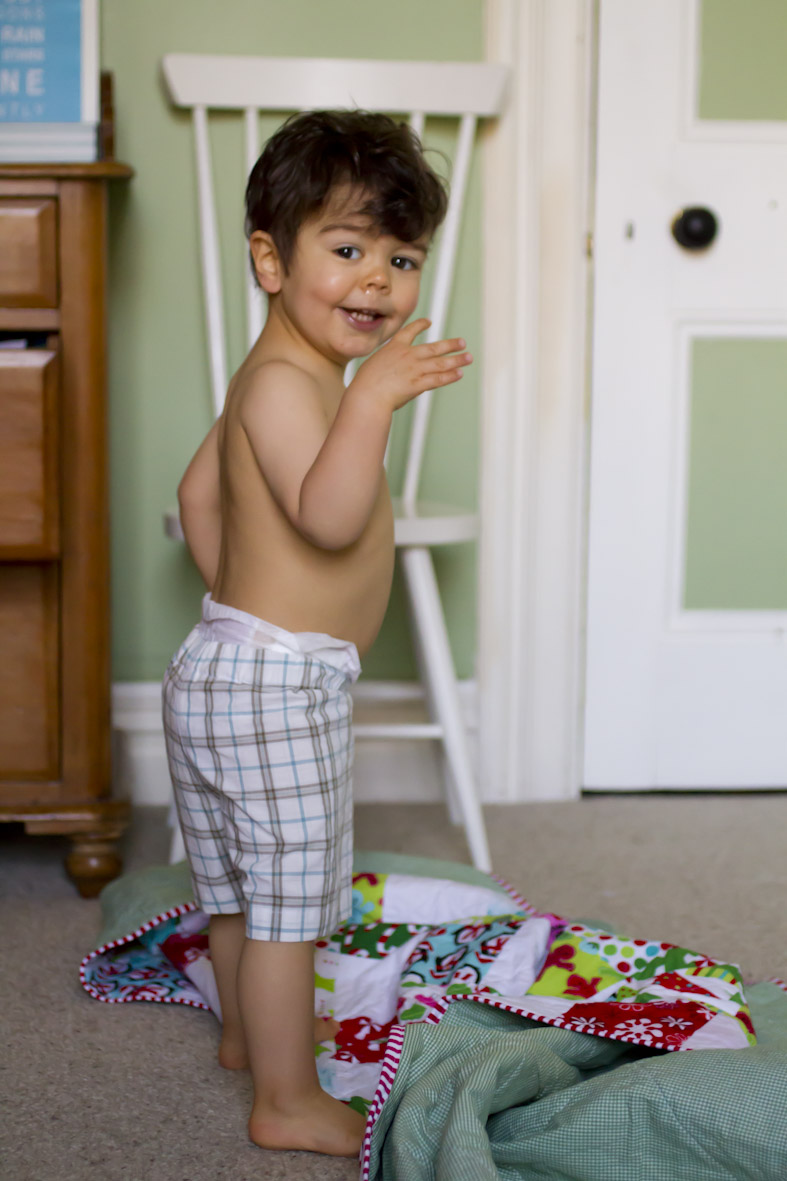
O Rodrigo tem três novos pijamas de Verão. Querem que vos conte mais coisas sobre eles?

1. A motivação
Já sabem que vamos passar uns tempos a Portugal e que lá o Verão é quente e as casas são uns verdadeiros fornos (pelo menos os apartamentos lisboetas... imagino que os solares minhotos que têm paredes com um metro de espessura sejam bastante mais frescos). Como qualquer criança (pessoa, aliás), o Rodrigo precisa de uns quantos pijamas leves — a minha ideia era fazer quatro ou cinco (por causa dos acidentes nocturnos), mas só tive tempo para acabar três. 

2. Os tecidos
Os calções foram feitos com três camisas antigas do Tiago. Como as camisas não tinham tecido suficiente para fazer pijamas completos, usei cambraia branca para as partes de cima e fiz as bandas (como é que se diz facing em português?) com bocados que sobraram das camisas  — foi uma maneira de tentar ligar as partes de baixo às partes de cima. Terei sido bem sucedida? Uhm... o Tiago disse que lhe lembrava um palhaço rico (simpático...); eu acho que ficou com um ar assim à anos 20. É verdade que poderia ter escolhido um molde diferente — um clássico casaco de pijama, por exemplo — mas admito que tive preguiça de estar a coser colarinhos e aquela parte central cujo nome também não sei em português (placket? isto está bonito...) e inúmeras casas de botões e outras coisas que tais. O que me leva ao próximo ponto:

3. Os moldes
Fiz os calções com base no KID Shorts Made. A parte de cima é o Sailboat Top da linha Oliver+S com algumas alterações: encurtei as mangas e cortei as tais bandas em tecidos contrastantes e depois cosi-as do lado de fora (é suposto serem feitas no mesmo tecido e cosidas no avesso). Por que é que não me limitei a fazer os calções e depois comprar t-shirts brancas? Porque sou uma maníaca encalorada e acho que a cambraia é bastante mais fresca do que a malha das t-shirts.

4. O(s) tamanho(s)
De acordo com as medidas do Rodrigo, comecei por fazer o primeiro pijama (o que aparece nas fotografias 1, 2 e 3) no tamanho dois anos (ele tem um ano e meio). Quando lhe vesti as peças, estavam justas. Dariam para este Verão mas já não serviriam no Verão neozelandês. Então resolvi fazer os outros pijamas no tamanho três anos (com os calções mais curtos). Entretanto o pequenote ficou doente, deixou de comer e emagreceu (isto assim descrito parece ultra-dramático). E agora o tamanho dois anos já lhe assenta que nem uma luva.

5. As costuras
Os calções são fáceis e já os consigo fazer de olhos fechados (já vou no sétimo par). As partes de cima deram mais trabalho, principalmente as mangas. Não gosto nada de embeber mangas! Ainda por cima armei-me em perfeitinha e resolvi rematar as costuras de uma maneira xpto... e acabaram por ficar bastante trapalhonas. Mas enfim, os pijamas servem e neste momento isso é que interessa!


Rodrigo's got three new summer pyjamas. Should I tell you more about them?

1. The motivation
I've told you that we're going to spend some time in Portugal soon and that summers there are hot and homes feel like ovens (at least Lisbon flats do... old stately homes made of stone with metre thick walls are much cooler). Just like any child (person, really), Rodrigo needs a few light pyjamas — my plan was to sew four or five but I only managed to finish three.

2. The fabrics
For the shorts I used three of Tiago's old shirts. Because there wasn't enough fabric in the shirts to make complete pjs (you know, the classic ones where the shirt and the shorts are made with the same fabric), I used white batiste for the tops and cut the facings using whatever was left from Tiago's shirts after cutting the shorts — this was my attempt at trying to match the tops and bottoms. Did I succeed in my efforts? Uhm... Tiago said it reminded him of a clown (nice...); I reckon there's a sort of 1920s look to it. I know I could have chosen a different pattern for the top but I confess I didn't want to bother with collars and plackets and numerous buttonholes and the like. Which leads me to my next point:

3. The patterns
The shorts were made using the KID Shorts Made pattern. The top is the Sailboat Top from Oliver+S with some alterations: I shortened the sleeves and cut the facings in a contrasting fabric and stitched them on the outside of the garment (they're supposed to be made in a matching fabric and sewn on the inside). Why didn't I just sew the shorts and bought some white t-shirts? Because I abhor hot clothes and I believe batiste is much cooler than t-shirt jersey.

4. The sizing
Given Rodrigo's measurements I started by making the first pjs in a size 2 (he's 18 months old). When I tried them on, both the shorts and the top were a little too snug. I mean, they'd work for now but they wouldn't fit him when summer arrived in NZ. So I decided to make the other two pjs in a size 3. In the meantime, the little boy got ill and lost some weight (goodness, this sounds overly dramatic), which means that the first pjs are now a perfect fit.

5. The sewing bit
The shorts are easy and I can almost sew them with my eyes closed (I'm currently working on my 7th pair). The tops were a little more time consuming, especially the sleeves. I don't like setting in sleeves! On top of that, I figured I should flat-fell the sleeve seams and they ended up turning out quite wonky. But hey, they work and that's what matters right now!

(photos: © Constança Cabral)

18 August 2013

WIPs


Estes últimos dias têm sido atípicos — entre tremores de terra e uma virose que se apoderou do corpo do Rodrigo e que teima em querer ficar por lá, o meu surto de produtividade sofreu um abanão. Mas, graças ao Instagram, posso mostrar-vos uns vislumbres daquilo que têm sido os meus dias (as partes mais desinteressantes e difíceis não são para aqui chamadas):

- pijamas: ando a fazer pijamas de Verão para o meu rapazinho. Já sabem do meu horror a tecidos muito grossos no Verão... tenho aproveitado as camisas mais leves que o Tiago já não usa para cortar calções. As partes de cima estão a ser feitas com cambraia branca e restos dos tecidos das camisas. Quando estiverem acabados hei-de escrever um post sobre o assunto;

- fatos-de-banho: aproveitei uns calções antigos do Tiago para fazer um fato-de-banho para o Rodrigo (notam aqui um padrão? é verdade, farto-me de guardar roupa antiga para aproveitar um dia mais tarde). Estou a fazer mais alguns mas estes de algodão normal, porque já não tenho mais calções antigos para usar. Mas já sei que há uns quantos pares à minha espera em Lisboa!

- coser: não costumo deixar o Rodrigo à solta no escritório por causa dos alfinetes, agulhas e outros perigos do género. Mas ele está tão farto de estar enfiado em casa que deixei-o satisfazer a curiosidade em relação à máquina de costura;

- forrar prateleiras: mandámos fazer umas prateleiras para um armário que herdámos dos avós do Tiago (aqui está ele). Vai passar a ser o nosso armário da roupa de casa e as prateleiras (em MDF) estão a ser forradas num tecido branco com flores azuis que comprei em super-saldos;

- terramotos: felizmente o epicentro destes tremores de terra recentes na Nova Zelândia ainda é relativamente longe de nós, mas a casa tem abanado de vez em quando e digo-vos que é assustador. A nossa casa é toda de madeira e está construída sobre estacas, o que significa que, quando há um terramoto, parece que estamos em alto-mar. Até ficamos enjoados a seguir!


These past few days have been rather atypical — between earthquakes and a nasty virus that has taken over Rodrigo's body and insists on not going away, my productivity has suffered a sharp decline. However, thanks to Instagram I can show you peeks into my days (the uninteresting and challenging parts have been left out):

- pyjamas: I'm making summer pjs for my little boy. I've already told you how much I dislike thick fabrics in high summer... so I've grabbed some of the lighter shirts Tiago no longer wears and I've been cutting shorts out of them. For the tops I chose white batiste with facings cut from scraps of the shirt fabrics. Once I'm finished I'll write a post telling you all about them;

- bathers: I took a pair of swim shorts Tiago hasn't worn for years (do you notice a theme here? yes, I do hang on to lots of old clothing in the hope of refashioning it one day) and used them to make swim shorts for Rodrigo. I'm making a few more bathers using regular cotton fabrics because I've ran out of old swimwear but I know there are some waiting for me in Lisbon!

- sewing: usually I don't let Rodrigo into my workroom because there are too many pins and needles and other dangers lying about but he's so sick of being shut up at home that I've let him satisfy his curiosity towards the sewing machine;

- covering shelves: I had some shelves made for an old wardrobe that we've inherited from Tiago's grandparents (here it is). It's going to be our linen cupboard from now on and I've covering the MDF shelves with a classic blue and white floral print I found in the super clearance corner of the fabric shop;

- earthquakes: fortunately for us, the epicentre of these recent NZ quakes is further south but we've sure been feeling the house shake from time to time and it's been quite frightening as we're not used to these events. Our house is all timber and built on piles so it shakes like we're on a boat. We even get sea sick when it stops!

(photos: © Constança Cabral)

14 August 2013

Missão do Momento :: My Present Mission

Tenho uma nova missão. Aliás, presentemente até tenho duas missões, sendo que uma fica no caminho para chegar à outra. A minha missão mais grandiosa é esta: dominar a arte da confecção. Olhar para uma folha de moldes sem que o nervoso miudinho se instale. Ter orgulho no avesso da roupa feita por mim. Dominar técnicas como embeber uma manga, forrar um vestido, aplicar um entremeio. Aprender a desenhar e alterar moldes. Olhar para uma peça de roupa numa loja e pensar  "consigo fazer isto nas calmas".

(A missão menos grandiosa mas mais imediata é completar o guarda-roupa de Verão do Rodrigo. Tenho andado a fazer calções e pijamas como se não houvesse amanhã!)

Quando uma pessoa se interessa a sério por um tema deve tentar aprofundá-lo ao máximo, não é verdade? Empiricamente ou de forma mais académica, o que interessa é conseguir estar o mais à-vontade possível no campo em questão. Pois eu, apesar de me ter iniciado nas artes da costura há 7 anos (já?), tenho sido uma mera curiosa. Curiosa e diletante.

Mas finalmente senti o chamamento e estou disposta a tornar-me um ás. Para isso há que ler umas coisas, ter umas aulas e, principalmente, fazer. E já estou a ver progressos! Olhem só este exemplo:


I'm on a mission. Actually, at present I'm on two missions but one is on the path get to the other one, the greater mission. What great mission is that, you may ask? Mastering the art of dressmaking. I want to look at a pattern sheet without feeling nervous. I want to be proud of the wrong side of my handmade clothes. I want to conquer tasks such as setting in a sleeve, lining a dress and inserting lace. I want to learn how to draft and alter patterns. I want to look at a piece of clothing in a shop and think "I could make that".

(The lesser but more pressing mission is to complete Rodrigo's summer wardrobe. I've been making shorts and pyjamas like there's no tomorrow!)

When you're truly interested in a subject you should try and dig a little deeper, right? Either empirically or in a more academic fashion — the goal is to feel completely at easy in that particular field. Well, I've been sewing for 7 years (already?) but think I've been a bit superficial. Superficial and dilettante. 

But finally I've felt the calling become a sewing ace. In order to do that, I've got to read a lot, attend some classes and, above all else, experiment with things. And I'm already making some progress! Just take a look at this:


Fiz estas calças de pijama para o Rodrigo há três meses (já lhe estão curtas, mas isso é outra história). Depois de cosidas as costuras, limitei-me a cortar as margens com uma tesoura em zigzag. Ao fim de algumas (muitas) lavagens, estão feias. Muito feias. Irão aguentar-se mais uns meses, sem dúvida. Mas não me orgulho especialmente delas.

I sewed these pyjama bottoms for Rodrigo three months ago (they're getting too short but that's a whole other story). After stitching I simply pinked the seams. After some (many) washings they are looking ugly. Very ugly indeed. They'll do the job for a few more months, no doubt. But I'm not especially proud of them.


Agora vejam as costuras destes calções que estou a fazer (avesso na primeira imagem, direito na segunda). Têm melhor aspecto, não têm? Demoram o dobro do tempo mas ficam muito mais bonitas e resistentes. Cosi-as assim depois de ter lido este post da Rae a respeito de super costuras. Este post do blog Sew, Mama, Sew! também é bom. Não mais cortarei ou chulearei as costuras!

Now just take a look at these shorts I'm making (wrong side in the first picture, right side in the second one). They look much better, don't they? They take much longer but turn out much more pleasing and strong. I sewed them like this after reading Rae's post on super seams. This post on Sew, Mama, Sew is also quite informative. I vow not to pink or zigzag my seams ever again!


Estas calças de pijama também já foram feitas com super costuras: costuras inglesas nas pernas e costuras dobradas e pespontadas nos restantes sítios. Já agora, o molde que usei foi o Bedtime Story Pajamas da linha Oliver + S (tamanho 3 anos com mega bainhas).

Vou mantendo-vos a par dos meus progressos, combinado?


These pj trousers have also been sewed with super seams: I did French seams on the legs and folded and stitched down all the remaining seams. By the way, the pattern I used was the Bedtime Story Pajamas by Oliver + S (size 3 with huge hems).

I'll keep you posted on my progress, OK?

(photo: © Constança Cabral)

08 August 2013

Bibes :: Art Smocks


Na maior partes das casas com crianças pequenas, as horas das refeições são momentos delicados... e a nossa casa não é excepção. Há alturas em que o Rodrigo está bem-disposto e bem dormido e come tudo sem problemas: sopa, prato e sobremesa. Mas há aqueles dias em que o jantar é uma verdadeira batalha. Bem ou mal, fica sempre tudo sujo: ele, a mesa e o chão. Um babete não é suficiente — precisamos de um bibe por baixo do babete!

Há quem, para este efeito, goste muito de bibes impermeáveis, mas eu prefiro ter vários bibes em tecidos laváveis a altas temperaturas (mais vale uma nódoa de sopa do que sopa a escorrer). Mas cada mãe tem as suas preferências, claro. Em Portugal é muito fácil comprar bibes de todos os padrões e feitios; aqui nem por isso, porque crianças não usam bibes na escola — quando são mais velhos usam farda, mas os mais pequenos vão com a roupa de todos os dias. A solução? Fazer eu própria os ditos bibes!

O molde que usei foi o Art Smock do livro Little Things to Sew. Fiz cinco art smocks: dois com tecidos do Ikea (primeira e última fotografias) e três com camisas do meu pai (2ª, 3ª e 4ª fotografias). Os bibes feitos com as camisas foram os que me deram mais gozo, porque adoro aproveitar peças de roupa que, por uma razão ou outra, foram postas de lado.

Mais uma vez constatei a excelência de tudo o que a Liesl Gibson produz (conhecem a marca de moldes infantis Oliver + S?). As instruções são claras, a construção é inteligente e não há uma única costura exposta (foi a minha estreia nas costuras inglesas!). Fiz o tamanho mais pequeno que, apesar de estar à medida, é suficientemente espaçoso para usar por cima de camisolas e até mesmo de um roupão de Inverno.


Just like in every other home with small children, in our house mealtimes are delicate moments. There are days when Rodrigo is happy and well-rested and he eats everything: soup, main dish and dessert. But there are also those times when a meal is just like a battlefield. Either way, everything is dirty by the end of it: himself, the table and the floor. A bib simply isn't enough — we need a smock under the bib!

Some people like waterproof fabrics like oilcloth and laminated cottons for this effect but I prefer something that you can wash in a very hot cycle. I'd rather have soup stains than soup running down the smock... but of course every mother is different. In Portugal you can buy cotton smocks in every print and shape because children wear them to nursery and primary school; here in NZ things are different: children wear uniforms when they're older but when they're very young they just wear their normal clothes. The solution? Making them myself!

The pattern I used was the Art Smock from the Little Things to Sew book. I sewed five art smocks: two with Ikea fabrics (first and last pictures) and three with some old shirts my father no longer wears (2nd, 3rd and 4th photos). I especially enjoying making the bibs out of the old shirts because the fabrics are such good quality and because I love using up discarded items of clothing.

It was great to realise once again that everything that Liesl Gibson creates is of such high standard (are you familiar with  Oliver + S patterns?). The instructions are clear, the construction is very clever and there isn't a single exposed seam (this was the first time I ever made French seams!). I sewed the smaller size and have found it true to size but roomy enough to wear over sweaters and even a winter robe. Mealtime smocks: check!

(photo: © Constança Cabral)

07 August 2013

Passeio no Bosque :: Bush Walk


Sábado de manhã na Nova Zelândia.

Saturday morning in New Zealand.

(photo: © Constança Cabral)

05 August 2013

Portugal em Hexágonos :: Portugal in Hexagons


Depois de meses — anos! — a fazer hexágonos, finalmente completei o meu mapa de Portugal. Esta ideia surgiu-me ainda em Inglaterra, num dia de muita chuva e de muitas saudades de casa. Usei retalhos de projectos passados em tons de azul e verde e apliquei-os sobre um rectângulo de serapilheira. O método que segui para fazer os hexágonos foi o tradicional English paper piecing, em que um pequeno corte de tecido é alinhavado à volta de um hexágono de papel; depois os hexágonos são unidos uns aos outros com um ponto quase invisível e, por fim, os papéis são retirados e o patchwork é aplicado sobre um tecido base (esta parte final fiz à máquina com ponto zigzag).

After months — years! — of making hexagons I finally completed my map of Portugal. This idea presented itself to me while I was still living in England, during a particularly rainy day when I was missing home very much. I used scraps of fabrics from past projects in shades of blue and green and   stitched them on a rectangle of plain hessian. To make the hexagons I followed the traditional English paper piecing method, where a small cut of fabric is basted around a paper hexagon; the hexagons are then slipstitched to each other and finally the papers are removed and the patchwork is sewn onto a foundation cloth (I sewed this final step by machine using a zigzag stitch).


Para conseguir reproduzir o contorno do nosso querido país abri um mapa de estradas e fui colocando os meus hexágonos ao longo do recorte da costa e da fronteira com Espanha. Visto que os hexágonos eram relativamente grandes, tive de exagerar certas áreas e houve zonas em que foi particularmente difícil acompanhar as subtilezas geográficas (Lisboa, por exemplo). E que exercício sentimental foi este! É bom ver o resto do mundo mas as raízes de uma pessoa continuam a ter muita força. Que saudades de Portugal e que vontade tão grande de ir explorar os sítios que ainda não conheço!

In order to reproduce the shape of my dear country I opened up a road map and placed my hexagons along the coast and Spanish border. Since the hexagons were on the larger side I had to exaggerate some of the outlines and there were areas where it was especially difficult to represent the geographical subtleties with accuracy (Lisbon, for example). And what a sentimental exercise this was! It's great to experience the rest of the world but one's roots are incredibly strong. I miss Portugal!


(photos: © Constança Cabral)

04 August 2013

Flores de Inverno :: Winter Flowers


Ando feliz com as flores que tenho encontrado no nosso jardim. Estamos em pleno Inverno e há camélias, alfazema, heléboros, narcisos, jacintos, margaridas, sardinheiras, daphne e muitas outras cujo nome não conheço. E cheiram tão bem. Bem dizem que a terra é boa na Nova Zelândia!

I'm so happy with all the flowers I've been discovering in the garden. We're in the dead of winter and I've picked camellias, lavender, hellebores, daffodils, hyacinths, pelargoniums, daphne and others that I cannot name. And they smell heavenly. New Zealand soil is terrific!

(photos: © Constança Cabral)

02 August 2013

Me @ Pano P'ra Mangas


Hoje apareço no Pano p'ra Mangas — se tiverem curiosidade, espreitem aqui. Muito obrigada pelo convite, Margarida!

There's a little interview with me at Pano p'ra Mangas (in Portuguese only) — in case you're curious, check it out here. Thank you so much, Margarida!

Related Posts Plugin for WordPress, Blogger...