31 October 2011

Quilts & Quilting


Acredito realmente em fazer coisas à mão. Vale a pena o esforço; vale a pena o tempo; vale a pena o empenho. E um quilt é das coisas mais especiais que uma pessoa pode fazer. Escolher os tecidos para o patchwork, dispô-los de maneira agradável, cosê-los, acrescentar o recheio e o forro, acolchoar todas as camadas e, por fim, coser o debrum — todos estes passos levam a que cada quilt fique impregnado de emoções e bons sentimentos. Fazer um quilt é fazer uma coisa para a vida, é pensar que será usado vezes sem conta e acalentar a esperança de que as gerações vindouras lhe darão algum valor.

Apesar de já ter feito várias referências a quilts neste blog, sinto que chegou a altura de lhes dedicar uma série de posts mais detalhados. Ao longo dos próximos dias vou tentar fornecer algumas explicações e fontes de inspiração sobre este assunto, com o objectivo de desmistificar termos e técnicas e na esperança de contagiar-vos com o meu entusiasmo. Vamos a isto?

I really believe in making things by hand. It's worth the effort; it's worth the time; it's worth the commitment. And a quilt is one of the most special things a person can make. Choosing the fabrics for the patchwork, arranging them in a pleasing manner, piecing them, adding the wadding/batting and the backing, quilting all the layers and, finally, binding it all together — all these steps fill every quilt with emotions and good feelings. Making a quilt is making something for life, it's thinking that it will be used over and over again, it's hoping that future generations will look at it and appreciate it.


Despite the fact that I've often mentioned quilts in this blog, I feel it's time to dedicate them a series of more detailed posts. Throughout the next days I'm going to try to provide you with some explanations and inspiration sources regarding this subject, in the hope of demystifying words and techniques and of infecting you with my enthusiasm. Are you up for it?

(photos: Tiago Cabral)

24 October 2011

Pausa :: Pause


Vou estar uns dias fora — cá nos encontraremos para a semana. Até lá!

I'll be away for a few days — we'll meet again next week. See you soon!

(photos: Tiago Cabral)

23 October 2011

Outono Português :: Portuguese Autumn


Uma ida de fugida a Portugal deu para ver como o Outono é diferente em terras do sul. Tudo é mais seco, até os tons de verde, o campo tem um cheiro doce e o céu é azul.

[os arranjos de flores foram feitos por mim e o modelo é a minha amiga Mafalda]

A short trip to Portugal gave me a glimpse of how different autumn is down south. Everything looks drier, even the shades of green, the countryside is sweetly scented and the sky is blue.

[the flower arrangements were made by me and the model is my friend Mafalda]

(photos: Constança Cabral)

20 October 2011

Me @ Time Out Lisboa


Na Time Out Lisboa da semana passada. Foi uma grande surpresa para mim — muito obrigada, Catarina Figueira!

19 October 2011

Nemo


Recentemente fiz algo completamente novo e diferente: a minha interpretação de um desenho animado. Em causa estava o Nemo, personagem principal do filme de 2003 da Pixar, e uma amiga que tem uma ligação especial a ele. Procurei inspiração e instruções na internet mas nada encontrei — então fiz um desenho tosco de um peixe-palhaço e, com feltro, enchimento e dois botões, fiz o Nemo que podem ver nas fotografias. Se o voltar a fazer, terei de corrigir as barbatanas: é que o Nemo tem uma mais pequena do que a outra...

Recently I made something totally new and different: my own interpretation of an animated individual. In question was Nemo, the main character in Pixar's 2003 film, and a friend of mine who's got a special connection to him. I looked for inspiration and tutorials online but found nothing — so I made a rough drawing of a clownfish and using felt, toy stuffing and two buttons, sewed the Nemo you can see in the pictures. If I ever make it again, I'll have to adjust the fins: the thing that makes Nemo unique is that his right fin is much smaller than his left fin...

(photos: Tiago Cabral)

17 October 2011

Coin Quilt


O meu coin quilt está finalmente acabado! Comecei a cortar os tecidos em Março de 2009 e cosi toda a parte de cima (o chamado top) ao longo desse ano. Depois mudámo-nos para Inglaterra e ficou esquecido numa prateleira.... até que há dois meses lhe voltei a pegar. Acolchoei-o e debruei-o à mão durante muitos serões e agora está pronto para ir para o nosso quarto em Lisboa. Um quilt feito à mão é mesmo especial e o resultado compensa largamente todo o investimento que lhe dedicamos. Recomendo vivamente!

My coin quilt is finally finished! I started cutting fabrics back in March 2009 and sewed the top throughout that year. Then we moved to England and there it lay forgotten on a shelf... until I took it up again two months ago. I quilted and bound it by hand over many evenings and now it's ready to go into our bedroom in Lisbon. A handmade quilt is indeed something special and the result makes up for all the investment one puts in it. I highly recommend it!

(photos: Tiago Cabral)

14 October 2011

Autumn :: Bulb Planting


Chegou novamente a altura de plantar bolbos, tanto dentro de casa (para florirem durante o Inverno), como no jardim (para florescerem na Primavera). Esta semana comecei com jacintos (instruções aqui em cima) e narcisos-de-papel. Há um ano foi assim.

It's that time of the year again: bulb season has begun! You can now plant bulbs indoors (to bloom all through winter) and in the garden (for flowers next spring). This week I've started with some prepared hyacinths (instructions above) and paperwhite narcissi. Here's what happened last year.

(photos: Constança Cabral)

12 October 2011

Tricots de Bebé :: Knitting for Baby


Tenho a enorme sorte de ter uma mãe que sabe e gosta de tricotar. E um bebé é a desculpa perfeita para procurar lãs e modelos e fazer experiências. Há uns tempos recebi estes dois tricots pelo correio: um xaile azul (adoro o pormenor do ponto de cobertor a branco) e um saco-cama branco. Ouvi dizer que já há mais alguns à minha espera...

I'm incredibily lucky to have a mother who can and likes to knit. And a baby is the perfect exuse to look for yarns and patterns and to experiment. A while ago I received these two hand-knitted things by post: a blue shawl (I love the detail of the white blanket stitch) and a white sleeping bag. I hear there are more things waiting for me...

(photos: Constança Cabral)

11 October 2011

Licor de Abrunho :: Damson Liqueur


Às vezes ouvimos contar que as nossas avós e bisavós faziam licores em casa. "Extraordinário!", pensamos, "que senhoras industriosas." Pois hoje eu venho desfazer um mito: fazer licor em casa é facílimo. Há dezenas de receitas disponíveis (a minha edição do Pantagruel tem 18) mas no fundo trata-se sempre de deixar macerar a fruta em álcool, açúcar e especiarias.

As duas fotografias foram tiradas com um mês de intervalo: é o nosso licor de abrunho, no dia em que foi feito e hoje. No Natal será filtrado e engarrafado — e bebido. O método é simples: meio quilo de fruta, 125 g de açúcar fino, raspa de um limão, um pau de canela e uma garrafa de vodka: tudo para dentro de um frasco grande e limpo (caso estivéssemos a viver em Portugal, teríamos usado aguardente). Agitar todos os dias. Esperar tês meses. Filtrar e engarrafar. O mais engraçado de tudo é que usei um frasco que a minha bisavó materna usava para fazer os licores lá de casa.

Sometimes we hear our family tell tales of how our grandmothers and great-grandmothers used to make liqueurs at home. "How extraordinary", we think, "such industrious ladies". Well, today I'm going to undo this myth: homemade liqueurs are the easiest things. There are dozens of recipes available but deep down it all comes to letting the fruit macerate in alcohol, sugar and spices. 

The two pictures above have been taken with a month's difference: it's our damson liqueur the day it was prepared and today. By Christmas time we'll filter and bottle it — and drink it. Here's how we made it: half a kilo of fruit, 125 g of caster sugar, the zest of a lemon, one cinnamon stick and one bottle of vodka: all poured into a large, clean jar. Shake it every day. Wait 3 months, then strain and bottle it. The loveliest thing was that I utilised the jar my great-grandmother used to employ to prepare her own liqueurs. 

(photos: 1- Tiago Cabral; 2- Constança Cabral)

09 October 2011

Clutches com Botões :: Button Clutches


Após muitas, muitas horas a escolher a cor, o tamanho e a localização ideal de cada botão, posso finalmente dizer que há três novas clutches disponíveis na loja. Duas são feitas em linho grosso e cada uma tem mais de 100 botões cosidos a toda a volta (uma em tons de azul, a outra de castanho); a última é feita num algodão estampado com flores gráficas e tem 40 botões em tons de cinzento e preto cosidos apenas no centro. Estão as três aqui.

After many, many hours choosing the ideal colour, size and placement for each button, I can finally say that there are three new clutches in the shop. Two of them have been made in corse, unbleached linen and each of them has more than 100 buttons hand-sewn all around its top (one in shades of blue, the other in tones of brown); the third one has been made using a piece of cotton printed with graphic flowers and has 40 buttons in black and grey hand-sewn to its centre pannel. They're all available here.

(photos: Tiago Cabral)

07 October 2011

Arranging Autumn Flowers :: Guest Post @ { TheSneakPeaks }

[Este meu guia passo-a-passo de como fazer arranjos florais de Outono foi inicialmente publicado no blog {TheSneakPeaks} a convite da Ana. Podem ver o post original aqui.]

[My step-by-step guide on how to create autumnal flower arrangements was first posted at {TheSneakPeaks} by Ana's request. Check out my original post here.]


O ritmo das estações do ano nunca deixa de me surpreender e fascinar e gosto que o interior da minha casa vá reflectindo o que se passa lá fora. Uma das maneiras mais fáceis e eficazes de alcançar isso é através de arranjos florais sazonais. Sou grande apologista de flores de jardim e de campo. Sei que nem toda a gente tem a sorte de ter um jardim, mas há sempre a possibilidade de reservar um sábado ou um domingo para dar um passeio pelo campo — sabe bem mudar de ares e as beiras das estradas estão carregadas de flores, folhas e frutos interessantes. Estamos a entrar no Outono, a minha estação preferida aqui em Inglaterra (mudei-me de Portugal para Inglaterra em Janeiro de 2010), e a natureza está progressivamente a revestir-se de tons quentes e saturados: amarelos, magentas, castanhos... Inspirada naquilo que me rodeia, criei dois arranjos outonais e vou mostrar-vos como os fiz.

The rhythm of seasons never fails to impress and fascinate me and I like my home to be a reflection of what's going on outdoors. One of the easiest and most effective ways of achieving this is by creating seasonal flower arrangements. I'm a great fan of garden and country flowers. I know not everyone is lucky to have their own garden but you can always dedicate a Saturday or a Sunday to country pursuits — it feels great to see what nature has to offer and roadside verges are usually laden with interesting flowers, leaves and fruits. Autumn is upon us and it's definitely my favourite season here in England (I moved from Portugal to England in January 2010). Nature is dressing itself in warm, saturated colours: yellow, magenta, brown... Inspired by what surrounds me at the moment, I've created two autumnal arrangements and I'm going to show you how I made them.


Primeiro há que seleccionar flores, bagas e folhas para os nossos arranjos. Normalmente apanho tudo o que me chama a atenção e só depois decido o que usar em cada arranjo. Neste caso comecei por apanhar hortênsias, uma dália, algumas rosas e bagas de sabugueiro. Tanto no caso das hortênsias como das bagas de sabugueiro, escolhi propositadamente exemplares que não estavam perfeitos: as hortênsias já estavam um bocado passadas e picadas, e as bagas ainda não estavam completamente maduras. A forma como arranjo flores é muito espontânea e nada académica, e vão ver que algumas flores (como as rosas) ficaram de lado, enquanto que outras (ervilhas-de-cheiro, sedum, abrunhos silvestres e até amoras) aparecerão mais à frente. É importante retirar todas as folhas dos caules que ficarão submersas em água, porque apodrecerão rapidamente e contaminarão a água da jarra, o que significa que todo o arranjo se aguentará fresco menos tempo. Há também que escolher os recipientes para os arranjos: eu usei uma jarra de vidro transparente e uma forma de esmalte branco.

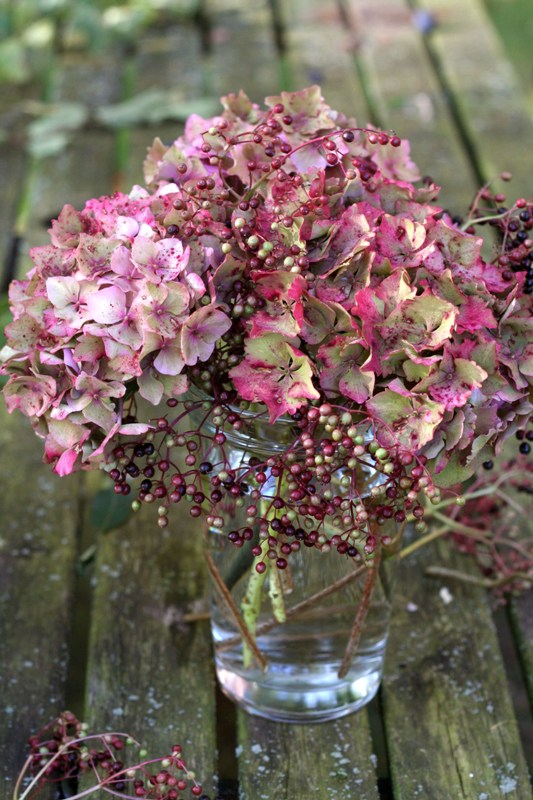
First you need to select the flowers, foliage and berries for your arrangements. I usually pick everything that grabs my attention and only later do I decide what to actually use in each arrangement. In this case I started by picking some hydrangea heads, one dahlia, a handful of roses and a few elderberries. I intentionally picked specimens that didn't look perfect: the hydrangeas are past their best and the elderberries aren't fully ripe yet. The way I arrange flowers is quite spontaneous and not academic in the least so you'll see that some flowers (like the roses) won't be used at all and some others (sweet peas, sedum, sloes and even blackberries) will put up an appearance later on. An important step is to remove the leaves from the lower portion of the flowers, as they'll rot quickly and will contaminate the water in the vase, making the whole arrangement last fewer days. You also must choose your containers: I picked a transparent glass vase and a white enamel jelly mould.


Comecei por fazer o arranjo maior, que pus dentro da jarra transparente. Normalmente faço os meus arranjos por camadas, e neste caso a primeira camada, formada pelas bagas de sabugueiro, serve para amparar as flores que se seguem.


I started with the largest arrangement, which was destined for the glass vase. I usually work in layers and in this particular situation the elderberries make a great first layer, as they'll anchor the rest of the flower stems.


Em seguida dispus algumas hortênsias entre as bagas.


Then I placed a few hydrangea heads amongst the berries.


Este arranjo foi feito no jardim e, enquanto estava a fazê-lo e fotografá-lo, dei de caras com um canteiro de sedum com um tom de cor-de-rosa perfeito para a ocasião. Claro que apanhei alguma flores e acrescentei-as ao arranjo.


While I was arranging and photographing this in my garden, a bunch of sedum flowers caught my eye. As they had the perfect shade of pink, I cut a few and added them to the vase.


A certa altura achei que o arranjo estava um pouco contraído e que lhe faltava algum movimento — então peguei em algumas ramagens de abrunhos silvestres (cuidado com os espinhos!) e dispu-las em direcções opostas dentro da jarra.

At this moment I felt the arrangement was a bit contrived and that it was lacking some movement — so I cut some sloe branches (watch those thorns!) and placed them in opposite directions within the vase.


Em seguida, dediquei-me ao arranjo mais pequeno. A técnica (se é que lhe posso dar este nome) que usei foi semelhante à do arranjo maior: comecei por dispor as bagas e flores mais carnudas (neste caso hortênsias)...


Then it was time to make the smaller arrangement. The technique (if I may call it that) I used was similar to how I made the larger arrangement: I started by setting out the berries and the fuller flowers (the hydrangeas in this case)...


... depois coloquei a dália em evidência e enchi os espaços vazios com sedum, ervilhas-de-cheiro e amoras.


... then I placed the dahlia in the most prominent spot and filled any gaps with sedum, sweet peas and even a bunch of blackberries.


Podem ver que ainda acrescentei dois ramos de abrunhos silvestres ao arranjo pequeno.

You can see that in the end I couldn't resist adding a couple of slow branches to the smaller arrangement.

E assim se fazem dois arranjos outonais, perfeitos para enfeitar um canto de nossa casa durante uma semana. Espero que gostem das minhas sugestões e que se aventurem com aquilo que encontrarem por esse campo fora.

And so we have two autumn flower arrangements, perfect for adding a bit of colour to a corner of your home for a week. I hope you like my suggestions and that you feel inspired to experiment with your own country finds.

(photos: Constança Cabral)